

IELTS: Why Hard Work Still Fails Some Candidates (And How to Fix It)
I’ve met this kind of student more times than I can count.
They’ve studied for months.
They’ve watched countless YouTube videos.
They’ve memorised vocabulary lists thick enough to qualify as a novel.
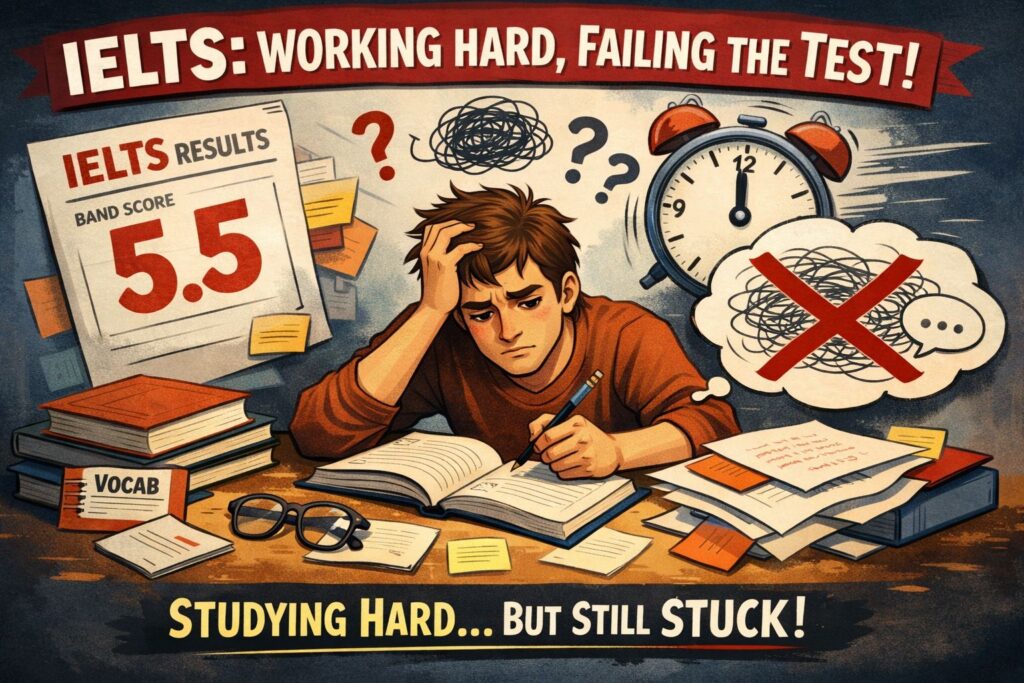
Yet, on result day, the score barely moves.
This isn’t laziness. It’s not lack of intelligence either. It’s something far more dangerous: preparing hard in the wrong direction.
Let’s talk about why this happens and how to fix it before your next test.
IELTS Is Not an English Test in the Way You Think
Here’s the uncomfortable truth most tutors won’t tell you early enough:
IELTS does not reward “good English” the way school exams do.
It rewards controlled performance under very specific rules.
I’ve seen fluent speakers score 6.0.
I’ve seen average speakers hit 7.5.
The difference was never talent. It was understanding the game.
The Silent Mistake Ruining Writing Scores
Most candidates believe that writing more complex ideas equals a higher band.
So they do this:
- Long introductions that say nothing
- Overloaded sentences with five ideas fighting for attention
- Examples that wander away from the question
IELTS examiners are not impressed by how much you write. They care about:
- How clearly you answer the question
- How logically ideas progress
- How accurately language is controlled
A simple, direct idea written clearly beats a “brilliant” idea written messily every single time.
If your essays feel intelligent but your score refuses to rise, this is usually why.
Why Speaking Feels Worse on Test Day
Many candidates speak well in practice but panic during the actual test.
That panic usually comes from one thing: lack of structure.
When you don’t know what kind of answer the examiner expects, your brain scrambles to invent one on the spot. That’s when:
- Answers become too short
- Grammar collapses
- Fluency disappears
High scorers don’t improvise.
They recognise the question type and respond with a familiar structure, almost on autopilot.
Confidence in IELTS Speaking is not confidence in English. It’s confidence in patterns.
Reading and Listening: Where “Almost Correct” Still Means Wrong
One of the hardest lessons for candidates is this:
IELTS does not reward intention.
If the instruction says NO MORE THAN TWO WORDS, three correct words equals zero marks.
If the answer is “children” and you write “the children”, it’s wrong.
These modules punish carelessness more than lack of knowledge. Speed without precision kills scores.
Top performers don’t rush. They move deliberately, knowing exactly what each question type is testing.
The Shift That Changes Everything
Every successful student I’ve worked with eventually makes this mental shift:
They stop asking, “How good is my English?”
And start asking, “How does IELTS reward answers?”
Once that happens:
- Writing becomes strategic, not emotional
- Speaking feels controlled, not scary
- Reading and Listening stop feeling like traps
Your score improves not because you studied harder, but because you finally studied correctly.
In conclusion, IELTS is fair, but it is not forgiving. It rewards those who understand its logic and punishes those who assume effort alone is enough.
If your exam date is approaching and your scores are stuck, don’t double your study hours yet. First, check whether you’re preparing for IELTS as a language test or as the performance-based exam it really is.
That distinction is where most people lose precious band scores without even realising it.